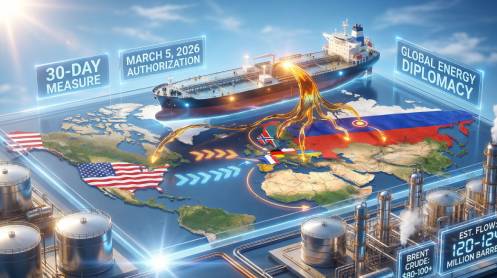
ANDOYA, NORWAY / MOSCOW: The United States has issued a 30-day waiver allowing countries to purchase sanctioned Russian oil and petroleum products currently stranded at sea, a move aimed at stabilising global energy markets but criticised by several European allies.
The decision, announced by Scott Bessent, US Treasury Secretary, allows the delivery and sale of Russian crude oil and petroleum products loaded on vessels on or before March 12, with the waiver remaining valid until April 11.
Bessent said the temporary measure was designed to ease volatility in global energy markets that have been shaken by the ongoing conflict involving Iran. However, critics argue the step could weaken Western efforts to cut off energy revenues that help finance Russia’s war in Ukraine.
According to Russia’s presidential envoy Kirill Dmitriev, the waiver could affect around 100 million barrels of Russian crude, roughly equivalent to nearly a day’s worth of global oil production.
The decision triggered sharp criticism from European leaders. Friedrich Merz, Chancellor of Germany, said easing sanctions on Russia was the wrong move. Speaking during a press conference in Norway, he said six members of the G7 had expressed strong opposition to the decision.
Germany’s Economy Minister Katherina Reiche suggested the move might have been influenced by domestic pressures within the United States.
Similarly, Norway’s Prime Minister Jonas Gahr Støre warned against weakening energy sanctions on Russia, echoing earlier concerns raised by Emmanuel Macron, President of France, and Ursula von der Leyen, President of the European Commission.
Meanwhile, the Kremlin welcomed the US move. Kremlin spokesman Dmitry Peskov said the decision aligned with efforts to stabilise global energy markets.
“The situation carries the risk of a growing crisis in the global energy sector,” Peskov said, adding that meaningful market stabilisation would be difficult without significant volumes of Russian oil.
Market data highlights the scale of oil currently in transit. According to analytics firm Vortexa, about 7.3 million barrels of Russian-origin oil are in floating storage, while 148.6 million barrels are being transported aboard vessels. Ship-tracking data from LSEG also shows up to 420,000 metric tons of diesel and gasoil currently in floating storage.
The US decision comes amid major disruptions to global energy supplies following military strikes by the United States and Israel on Iran, which have affected shipping through the strategic Strait of Hormuz.
The International Energy Agency (IEA) recently warned that the conflict in the Middle East is causing the largest oil supply disruption in history.
However, analysts believe the waiver may not significantly increase new demand. Vessel tracking firm Kpler said most cargoes already appear to have buyers, particularly in Asia.
“Most cargoes already appear to be placed with Asian buyers, particularly India. The measure mainly allows Russian barrels already in transit to complete their voyage and discharge,” Kpler said.
The decision also reflects concerns in Washington that surging global oil prices could harm US businesses and consumers ahead of upcoming political contests in the United States.
The sanctions waiver followed a recent phone call between Donald Trump and Russian President Vladimir Putin on March 9, as well as a visit to Washington by Kirill Dmitriev to discuss the energy crisis with US officials, including Trump’s envoy Steve Witkoff and his son-in-law Jared Kushner.
Following the announcement, Thailand signaled potential interest in purchasing Russian crude. Deputy Prime Minister Phipat Ratchakitprakarn said Bangkok was ready to begin discussions on possible imports.
Meanwhile, Japan also indicated it would consider whether to resume purchases of Russian crude in light of the temporary waiver.
By Reuters